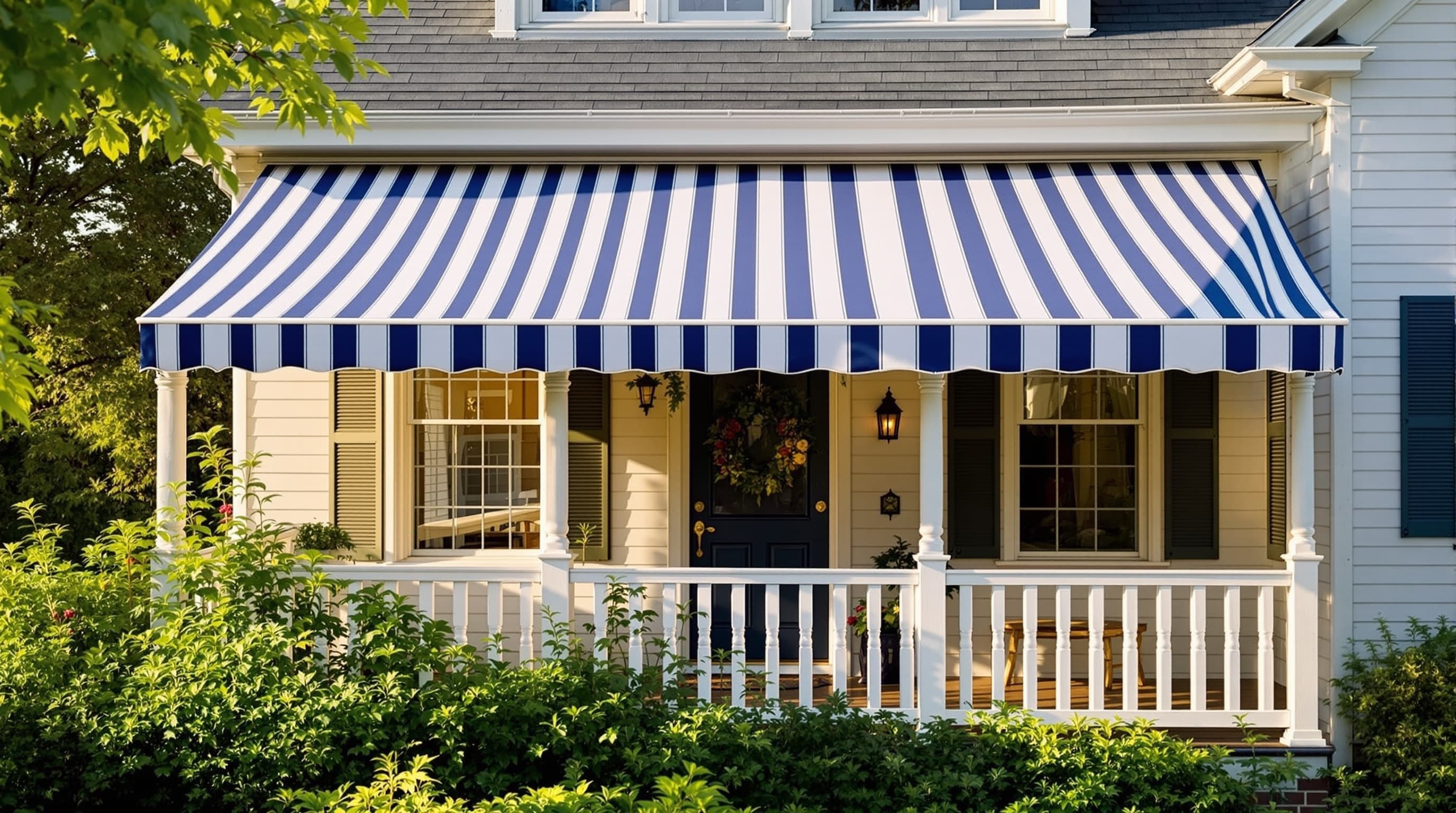
Best Awning Materials for Long Island's Salt Air and Coastal Weather
Not all awning materials are equal, and they are especially not equal on Long Island. The combination of ocean salt air, intense summer UV, high humidity, freeze-thaw cycling, and the occasional nor'easter creates a material-testing environment that will quickly reveal the difference between products engineered for coastal exposure and those that are merely adequate in mild climates.
This is a topic I know well — I have been installing awnings on Long Island since 2006, and I have replaced enough prematurely failed awnings to have very strong opinions about which materials belong here and which do not. This guide gives you the honest picture.
---
The Long Island Climate Challenge
Before discussing materials, it helps to understand exactly what they are up against here:
Salt air: Long Island is a narrow island surrounded by saltwater. Airborne sodium chloride particles deposit on outdoor surfaces year-round, accelerating oxidation on metals and degrading polymer coatings. Properties within 2 miles of the ocean, Great South Bay, Long Island Sound, or any tidal bay are in what I call the "aggressive corrosion zone." Properties farther inland still experience meaningful salt-air exposure from prevailing south winds.
UV radiation: Long Island sits at 40.7°N latitude, receiving moderate but significant UV loads. South and west-facing exposures receive the most intense daily UV. Combined with the reflective effect of sandy soil and open water (which increases effective UV by 15–25% over what you would see in a forested inland environment), UV degradation of fabrics and coatings is faster here than most of the country would suggest.
Humidity: Relative humidity on Long Island regularly exceeds 85% during summer, particularly in coastal communities. High humidity is a primary driver of mildew growth on organic materials and accelerates corrosion on unprotected metals.
Freeze-thaw cycling: December through March brings repeated freeze-thaw cycles that stress any material that absorbs water. Fabrics that have become water-saturated can suffer fiber damage from ice crystal expansion.
---
Fabric Materials: The Critical Choice
Awning fabric is the element that most homeowners focus on — and rightly so, because it has the most visible impact on appearance and is the component most likely to need replacement over the awning's lifetime.
Solution-Dyed Acrylic: The Only Correct Choice for LI
I am going to state this directly: solution-dyed acrylic fabric is the only fabric material worth installing on Long Island. Period. Here is what that means and why it matters.
In solution-dyed fabrics, the color pigment is added to the polymer solution before the fibers are extruded. The color is built into the molecular structure of every fiber — it cannot bleach, fade, or wash away from the surface, because it exists throughout the fiber, not just at the surface.
This is fundamentally different from solution-printing or pigment-printing, where color is applied to the fabric surface after weaving. Surface-applied colors are vulnerable to UV degradation from the moment they are exposed to sunlight.
Real-world result: A South Shore Long Island homeowner with a solution-dyed Sunbrella awning can expect good color retention for 8–12 years even in a direct oceanfront exposure. A homeowner with a polyester-print awning in the same location will see noticeable fading within 3 seasons.
Sunbrella (Glen Raven)
Sunbrella is the market leader in solution-dyed acrylic awning fabric, manufactured by Glen Raven in Burlington, NC. After 20 years of installing awnings on Long Island, I would choose Sunbrella for any application on this island.
Performance specifications:
- UV resistance: AATCC Test Method 16 — rated for 2,000+ hours of accelerated UV exposure with <3% color loss
- Mildew resistance: Does not support mold or mildew growth (acrylic fibers are non-organic)
- Water repellency: 450mm hydrostatic head minimum on all acrylic fabrics
- Warranty: 5 years against fading, mildew, rot, and staining
Long Island performance observations:
- Direct south shore (Long Beach, Atlantic Beach, Lido Beach): color holds 8–10 years
- South shore bay proximity (Freeport, Amityville, Bay Shore): 10–13 years
- Inland Nassau/Suffolk (Hicksville, Commack, Farmingdale): 12–15 years
- North shore (Great Neck, Port Washington): 11–14 years
Fabric weight: Sunbrella awning fabrics are 8–9 oz/sq yd. This weight is important — lighter fabrics (some are sold at 6 oz) have less inherent UV protection and less tear resistance.
Dickson Fabrics (Batis Inc.)
Dickson, manufactured in Roanne, France, is my other top recommendation. Dickson competes directly with Sunbrella at the premium tier and exceeds it in several areas:
- Color depth: Dickson's Orchestra and Illuminé collections have richer, more saturated colors than Sunbrella's comparable offerings. For the Hamptons and high-end Nassau County markets where design sophistication matters, Dickson is often the better choice.
- Texture: Dickson makes several fabrics with more pronounced weave textures that read as "fabric" rather than "coated membrane" — important for design-conscious clients.
- Acrylic plus PTFE option: Dickson's DCS+ fabric adds a PTFE (polytetrafluoroethylene) surface treatment that produces superior water beading and stain resistance compared to untreated acrylic.
Warranty: 5 years (standard); 7 years on select premium products.
Long Island performance: Essentially equivalent to Sunbrella in the same exposure category. I use Dickson when the design calls for it and Sunbrella when Sunbrella's wider color selection best matches the project.
Polyester Awning Fabrics: What to Avoid
I need to say this clearly because polyester awning fabric is widely sold and will underperform on Long Island:
Polyester fabric awnings are available at significantly lower price points — you will see them from mail-order awning companies and some big-box stores. They use a polyester base fabric with a surface-applied acrylic coating and printed colors.
On Long Island, in my direct observation, polyester awning fabrics typically show the following degradation timeline:
- Season 1–2: Looks fine
- Season 3: Color begins to bleach from the top surface; may show lighter lines where UV hits directly
- Season 4–5: Significant fading, possible delamination of the surface coating, mildew spots if the fabric is in a shaded humid location
- Season 5–6: Replacement needed
This is not acceptable performance for a product costing $600–$2,500 installed. The incremental cost of Sunbrella over a polyester fabric is typically $150–$350 on a residential awning — a worthwhile investment at any price point.
---
Frame and Structural Materials
Aluminum: The South Shore Standard
For any property within significant salt-air exposure (coastal zone), aluminum is the only frame material I will install. But not all aluminum is equal.
6063-T5 aluminum extrusion: This is the alloy specification used in commercial curtain wall systems and marine fittings. Better corrosion resistance than lower-grade aluminum alloys. All awning frames from SunSetter, Sunesta, and premium pergola manufacturers use 6063-T5 or equivalent.
Powder-coat coating grade:
- AAMA 2603: Minimum residential grade. 30% gloss retention after 5 years Florida test. Acceptable for inland properties.
- AAMA 2604: Recommended for all Long Island installations. 60% gloss retention after 5 years Florida test. This is our baseline specification for every project.
- AAMA 2605: Highest grade, typically used in commercial curtain walls. Some premium pergola manufacturers (Struxure) use this grade.
What happens with inadequate coating: Aluminum without proper coating develops white oxidation (aluminum oxide) that appears as a chalky, stained surface. In coastal Long Island environments, improperly coated aluminum awning frames can show significant oxidation within 5 years. Properly coated frames look fine at 20 years.
Anodized aluminum: An alternative to powder coat for smaller components. Anodizing creates an integral surface layer that is harder and more abrasion-resistant than powder coat. Used for hardware components in our coastal installations.
Steel: Never for Long Island Outdoor Applications
Uncoated or zinc-plated steel should not be used in any outdoor application on Long Island. Period. We see the results of this choice regularly when we repair competitor installations — rust bleed from steel screws staining awning fabric, oxidizing steel arm pins failing prematurely.
We use 316-grade stainless steel for all mounting fasteners and hardware components. 316 stainless is specifically formulated for marine environments (it is used in marine boat fittings for exactly this reason).
Wood (Cedar): When It Works and When It Doesn't
Western red cedar is appropriate for pergolas and outdoor structures in the right applications:
Works well:
- Inland Nassau and Suffolk County properties (more than 2 miles from saltwater)
- Properties where the aesthetic requires natural wood
- Homeowners committed to 3–5-year maintenance cycles (cleaning, staining)
Challenging:
- South Shore properties within 1 mile of bay or ocean
- Waterfront lots with direct exposure
- Absentee owners who cannot maintain the staining schedule
For challenging environments, aluminum pergola systems are the better choice despite their higher initial cost. See our Pergolas page for a full comparison.
---
Comparison Summary: Fabric Materials
| Material | Salt Air Rating | UV Resistance | Mildew Resistance | Typical LI Lifespan | Price |
|---|---|---|---|---|---|
| Sunbrella acrylic | Excellent | Excellent | Excellent | 10–15 years | $$ |
| Dickson acrylic | Excellent | Excellent | Excellent | 10–15 years | $$–$$$ |
| Polyester print | Poor | Fair | Fair | 4–6 years | $ |
| Acrylic/poly blend | Fair | Good | Good | 6–9 years | $–$$ |
| PVC coated poly | Poor | Poor | Poor | 3–5 years | $ |
---
Comparison Summary: Frame Materials
| Material | Salt Air Rating | Maintenance | LI Lifespan | Best For |
|---|---|---|---|---|
| Aluminum AAMA 2604 | Excellent | Minimal | 25–40 years | All LI applications |
| Aluminum AAMA 2603 | Fair | Low | 15–20 years | Inland only |
| Western red cedar | Good–Fair | Moderate | 15–25 years | Inland/design-led |
| Pressure-treated pine | Fair | Moderate | 15–25 years (painted) | Budget structures |
| Steel (coated) | Poor | High | 8–15 years | Not recommended |
| Stainless steel 316 | Excellent | Minimal | 30+ years | Coastal hardware |
---
Our Material Policy
At Long Island Shade Co., we do not offer customers the option to "save money" by using lower-grade materials that will fail in Long Island's environment. We will not install polyester fabric awnings. We will not use zinc-plated hardware on coastal installations. This is not us being rigid — it is us refusing to be responsible for a product that will disappoint our customers within a few seasons. Our reputation in the Nassau and Suffolk County market depends entirely on the awnings we installed still looking good a decade later.
Call (631) 565-8314 or [request a free estimate](/contact/) — we will specify exactly the right material for your specific location and exposure on Long Island.
Long Island Shade Co.
Awning & Pergola Specialists
Long Island Shade Co. has been fabricating and installing awnings across Nassau and Suffolk Counties since 2006 — the same crew that shows up for your estimate finishes your job.