Awnings and Canopies on Long Island: Types, Costs, and What Lasts in the Salt Air
Long Island homeowners shopping for outdoor shade run into the same wall: there are five or six distinct product categories that all get called "awnings" or "canopies," they vary in cost by a factor of 30x, and the one that lasts fifteen years in Smithtown may look terrible after four years in Bay Shore. This guide breaks down every major type, what they cost installed in 2026, and — critically — what actually holds up in Long Island's salt-air coastal environment.
---
The Major Types: What You're Actually Choosing Between
Retractable Fabric Awnings
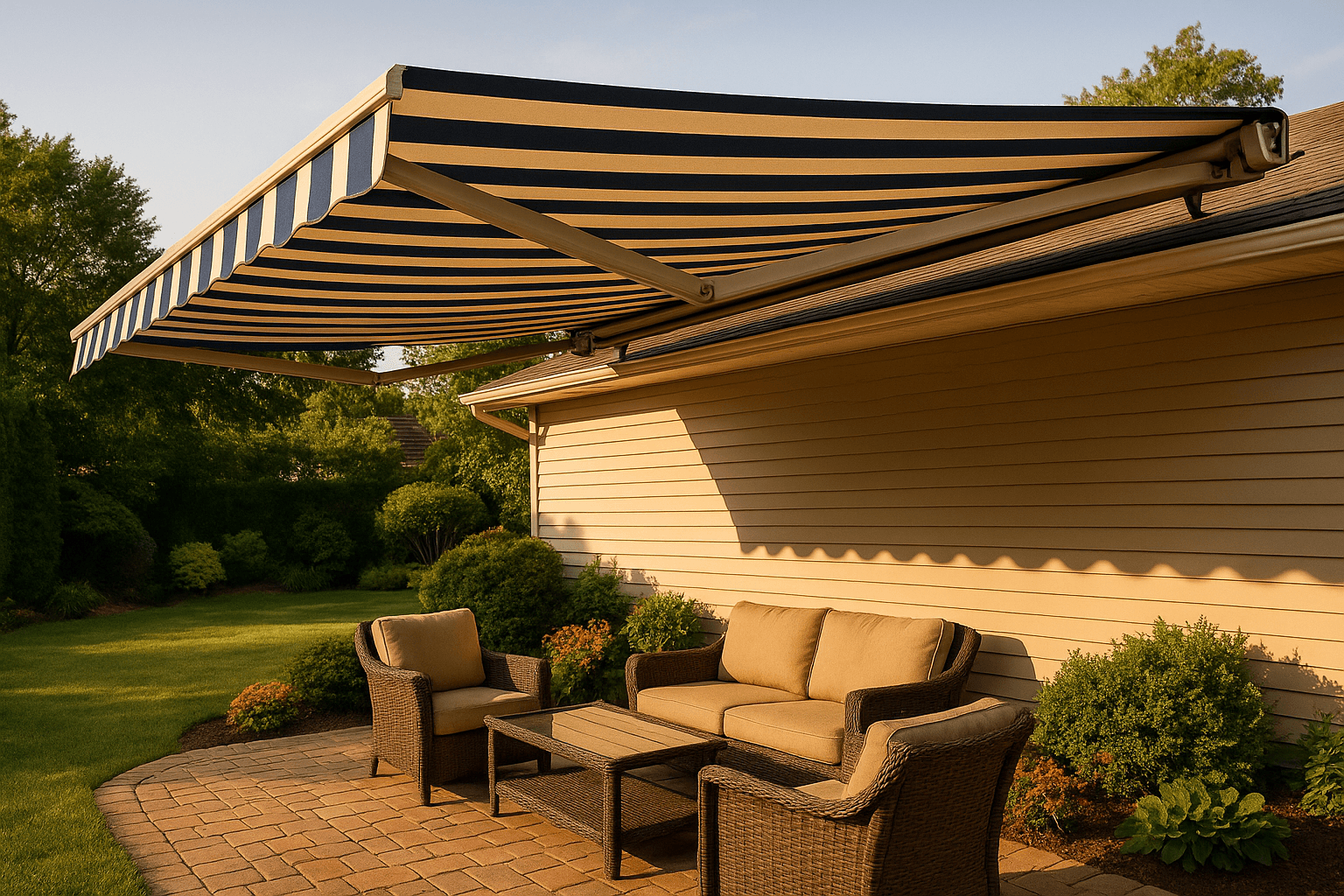
The most popular residential choice on Long Island. A motorized or manual awning rolls out over a patio on articulating arms, then retracts when not in use or before a storm. The retract capability is critical here — Long Island's nor'easters and sudden summer thunderstorms will destroy a fabric awning that can't get out of the wind fast enough.
Best for: South-facing patios, homes where aesthetics matter, homeowners who want motorized convenience and sensor protection.
Salt-air durability: Entirely dependent on fabric choice (see below). The aluminum frame components hold up well with powder-coat finishes. Motorized versions with wind sensors are the right call for anything within a mile of the South Shore.
Fixed Aluminum Canopies
A permanent aluminum frame with a solid or louvered aluminum roof panel, typically attached to the house fascia or set on independent posts. No fabric, no retraction — these are built structures. Nassau and Suffolk counties generally require permits for attached structures.
Best for: High-use areas where you want permanent weather protection year-round without maintenance — over a side entrance, basement walkout, or frequently used back patio.
Salt-air durability: Excellent. Powder-coated aluminum does not rust, does not fade, and does not require seasonal maintenance. These are the lowest-maintenance option for waterfront or near-water properties.
Polycarbonate Panel Canopies
Similar frame construction to aluminum canopies but with translucent or clear polycarbonate roof panels instead of solid aluminum. Lets light through while blocking rain.
Best for: Patio areas where you want natural light without full exposure. Popular over pool decks and in-ground spa areas.
Salt-air durability: Good, but polycarbonate panels yellow over time with UV exposure — typically 10–15 years before replacement is needed. Solid 16mm twin-wall or triple-wall panels outperform thinner single-sheet options.
Motorized Pergolas (Louvered Roof Systems)
The premium segment. An aluminum or steel pergola frame with motorized louver blades that rotate open (for sun and airflow) or close (for full rain protection). When fully closed, quality systems are fully weathertight. High-end brands include Luxaflex, StruXure, Corradi, and Renson.
Best for: Homeowners investing in an outdoor living space — outdoor kitchens, entertaining areas, full-season patios. The functionality of a retractable awning plus the permanence and structure of a canopy.
Salt-air durability: The best of any category when properly specified. Marine-grade aluminum extrusions with PVDF powder coat (not standard polyester coat) hold up within 100 feet of salt water without special maintenance.
---
Materials and Salt-Air Durability
This is where Long Island decisions diverge from national buying guides, which are written for inland markets.
Fabric: Solution-Dyed Acrylic vs. Everything Else
Solution-dyed acrylic (Sunbrella, Dickson, Recacril): The pigment is baked into the fiber during manufacture, not applied as a surface dye. UV and salt spray cannot strip or fade what is built into the material. Quality solution-dyed acrylic holds color and structural integrity for 10–15 years in coastal Long Island conditions with normal cleaning.
Standard polyester: Surface-dyed. Salt air and UV attack the surface coating. Fading begins in 2–3 seasons in South Shore conditions. We do not recommend polyester fabric for any Long Island installation within 5 miles of the water.
Acrylic-coated polyester blends: Better than standard polyester, worse than solution-dyed acrylic. Some mid-range SunSetter models use this. Acceptable for mid-Suffolk or Nassau County applications away from the shore; not the right call for waterfront.
Frame Metals
Powder-coated aluminum: The standard for retractable awning arms and canopy frames. Performs well in salt air. Look for 50+ micron powder coat thickness for waterfront applications.
Galvanized steel: Used in some pergola systems. Holds up well if the galvanization is intact, but scratches create rust points. Aluminum outperforms galvanized steel near salt water.
---
2026 Cost Guide: Long Island Installed Prices
| Product Type | Low End | Typical Range | High End |
|---|---|---|---|
| Basic fixed fabric awning (manual, 10–12 ft) | $800 | $1,200–$2,000 | $2,500 |
| Retractable motorized awning (14–18 ft, SunSetter) | $2,500 | $3,200–$4,500 | $5,500 |
| Retractable motorized awning with sensors (18–22 ft, Sunesta) | $4,000 | $4,500–$6,000 | $7,500+ |
| Fixed aluminum canopy (10 × 12 ft) | $3,000 | $4,500–$6,000 | $8,000+ |
| Polycarbonate panel canopy (12 × 16 ft) | $4,500 | $6,000–$9,000 | $12,000+ |
| Motorized louvered pergola (12 × 16 ft) | $8,000 | $12,000–$18,000 | $25,000+ |
These are fully installed Long Island prices including permits where required, labor, hardware, and material. They reflect Nassau and Suffolk County labor rates, which run 20–30% above national averages.
---
Nassau vs. Suffolk: Salt Air, Permits, and Key Differences
Salt-Air Exposure Zones
Salt-air corrosion accelerates within roughly 1–3 miles of the ocean or bay coastline. The highest-risk zones for fabric fading and metal corrosion are:
- South Shore Nassau: Long Beach, Atlantic Beach, Point Lookout, Oceanside, Lido Beach
- South Shore Suffolk: Bay Shore waterfront, Fire Island ferry areas, the Barrier Beach communities, ocean-facing East End towns
For these locations, solution-dyed acrylic fabric and PVDF or marine-grade powder coat aluminum are the correct specs. Standard polyester fabric and standard epoxy powder coat are the wrong specs.
Mid-Nassau and mid-Suffolk (more than 5 miles from any waterfront) face the same coastal humidity but at lower salt-concentration levels. Standard Sunbrella acrylic and standard aluminum powder coat are appropriate here.
Permit Requirements
Nassau and Suffolk counties both typically require building permits for permanently attached structures — aluminum canopies, polycarbonate canopies, and any pergola structure. General rules:
- Retractable awnings: Usually permit-exempt if mounted to the existing fascia without structural modification, but this varies by municipality. Check with your local building department.
- Permanent attached canopies: Permits almost always required in Nassau and Suffolk. Setback rules apply — the structure cannot extend to within a certain distance of property lines.
- Freestanding pergolas: Permit requirements vary by size and municipality. Structures under a certain square footage threshold (often 144 sq ft in NY) may be exempt in some jurisdictions.
We handle the permit process for all permitted projects. Clients provide property survey documents; we do the rest.
HOA Considerations
HOA communities are concentrated in Nassau County — Levittown, Massapequa Park, parts of Syosset, many condo developments. If your community has an HOA or architectural review committee, get written approval before ordering any permanent structure. Rules typically govern color, style, setback from fence lines, and whether motorized equipment is allowed. Retractable awnings are generally lower-friction HOA applications than canopies or pergolas.
---
Internal Links
If you are still deciding between product types, our retractable awnings service page and awnings and canopies overview have project examples from Long Island homes. Our pricing guide shows current installed costs with typical size breakdowns.
Ready to move forward? Request a free in-home estimate and we will measure your space, discuss options, and provide a written proposal — usually within 24 hours of the site visit.
Frequently Asked Questions
- Do I need a permit for an awning on Long Island?
- Retractable fabric awnings are usually permit-exempt on Long Island if they attach to the existing fascia without structural changes, though rules vary by municipality. Permanent attached canopies and pergola structures almost always require a Nassau or Suffolk County building permit. We handle the permit process for all projects that require one.
- What awning fabric lasts longest near the Long Island waterfront?
- Solution-dyed acrylic fabrics (Sunbrella, Dickson, Recacril) are the only fabrics we recommend for homes within a few miles of salt water. The pigment is built into the fiber rather than applied as a surface dye, so UV and salt spray cannot fade or degrade it. Standard polyester fabrics can fade visibly within 2–3 seasons on the South Shore.
- What does a motorized retractable awning cost on Long Island in 2026?
- Fully installed, a motorized retractable awning on Long Island runs approximately $2,500–$5,500 for a 14–18 ft wide unit, and $4,000–$7,500 for a larger premium unit with sensors. These are Long Island prices including labor — about 20–30% higher than national averages due to regional labor rates.
- What is the most durable outdoor shade option for a South Shore waterfront home?
- A fixed aluminum canopy or motorized louvered pergola with marine-grade powder-coated aluminum is the most durable option for direct waterfront exposure. These structures use no fabric that can fade or tear, require minimal maintenance, and hold up to salt air indefinitely with quality finishes. Motorized pergolas add the flexibility of adjustable airflow and light control.
Long Island Shade Co.
Awning & Pergola Specialists
Our crew has installed awnings and canopies across Long Island since 2006, working on one simple principle: the same crew that shows up for the estimate finishes the job.